martes, 3 de abril de 2012

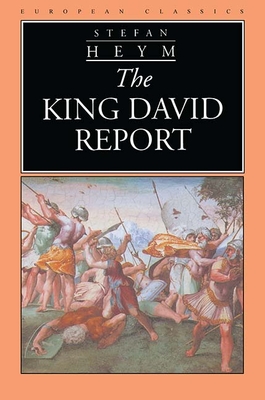
The King David Report

by Stefan Heym

At the beginning of February I asked someone with a large book collection what German author he would recommend. He handed me The King David Report, by Stefan Heym. He had actually purchased a copy of the book in English for the sole purpose of encouraging more non-Germans to read it. I am delighted he did. Named after an actual document found in the Old Testament, the novel is narrated by the author of said document, beginning with a seemingly harmless request from the titular king's son Solomon that his father's history be recorded. On the surface, the book can be thought of as a speculatively fictional behind-the-scenes bonus feature of the Bible. Heym takes the source text to illustrate, in a very plausible way, how might an ancient king's court deal with the making of history. In one hilarious scene, the committee discusses the cicumstances of David's meeting with Saul, his predecessor (and eventual usurpee). Everybody knows that David first met Saul when he was called to play music for the ailing king. But everybody also knows that Saul met David after demanding to see the boy who smote the phearsome Philistine Goliath. In the end it is decided that both should be included as historical record (as it is in the actual Bible). Finding the truth(s) about David's life is the task of Ethan, the narrator. But as he learns more about the real David, he finds himself torn between conveying the accurate and unflattering or the glorifying. It makes for a gripping tale of mystery, lust, and murder, all told with refreshingly dry biblical prose. You'd never guess that the book is also hilarious (it is!).

But it's not until one takes Heym's context into consideration that the value of the novel really comes to light. Any book written by an East German in 1973 is likely to be infused with criticism of the regime, and The King David Report is no exception. Themes in the novel – David's utopian kingdom, the editing of the past, the shiny surface of Solomon's temple-in-progress – all reflect Heym's times. As he says himself in the Author's Note, "Opinions might also differ on the question of whether The King David Report is to be considered a historical novel or a biblical one, or a story of today, charged with political meaning. To me, it is all three." Read this book!

miércoles, 8 de junio de 2011

Arclight Cinemas


Hollywood, CA
2nd Floor

Context is everything. But I suspect that even had I not sipped from this fountain immediately after being washed over by Terrence Malick's nourishing film The Tree of Life it would have left much to be desired. Anticipating a life affirming gulp of the very substance that enables our fragile existence on this tumultuous planet, I was instead met with a lukewarm lob of runoff. It was anything but an Arclight coming out of this poorly aligned stainless steel spout. Try as I might, it seems no amount of ponderous visual meditation on what it is to live will eliminate the dead taste from my mouth.

Taste: 4
Comfort: 3
Temperature: 5
Trajectory: 4
Pressure: 2
User Interface: 3

viernes, 26 de febrero de 2010

Never Let Me Go


by Kazuo Ishiguro

Recently I have found that books usually tend to win me over or lose me completely within their first few pages. Here's one that managed the former very easily, with its beautiful narration and thin shroud of mystery. It begins innocently enough, with the adult Kathy telling her story of growing up in an English preparatory school. Still, one can tell that there's something hidden in the recount that is a little bit... off. I am reluctant to reveal anything more about the plot, as I feel much of my enjoyment of this book came from knowing nothing about it beforehand. Ishiguro manages to give an extremely convincing voice to an unlikely class of characters. Upon finishing, one might protest that certain elements were left unexplained. I claim that by neglecting to provide answers the author adds to the strength and credibility of the narration. That is, the questions the reader has are questions that the narrator would never think to ask. Ishiguro remains defiantly faithful to his characters' perspectives, and in doing so denies his readers immediate gratification in favor of a more affecting outcome. Read this book!

miércoles, 9 de diciembre de 2009

Marcus Cinema


Marcus Oakdale Ultrascreen Cinema
Oakdale, MN
West Side

Eating popcorn tends to leave the viewer of even the most satisfying film with an uncomfortable thirst. Sadly, thanks to our country's obsession with enormous fountain drinks, the water fountains in movie theaters are often neglected by both patron and proprietor. It follows that I was pleasantly surprised to find this water fountain (pictured left) not merely a cheap and easy method to wash away residue salt from my palate, but indeed a source of hydratory delight! Go for the movie, stay for the water!

Taste: 10
Comfort: 4
Temperature: 9
Trajectory: 6
Pressure: 7
User Interface: 8

viernes, 25 de septiembre de 2009

A Prayer for Owen Meany


by John Irving

Within fifty pages of this quarry of a novel, Irving makes it clear that his story will not end cheerfully. That is, if the reader has not already gathered that from the hilariously telling name of the New Hampshire town in which it is set, Gravesend. Though this does cast a grim shadow on the book, it somehow also enhances the reader's appreciation for the narrative's lightheartedness. It is told by Johnny Wheelwright, a forty-something-year-old expatriate living in Toronto. Jumping back and forth between his experience growing up in Gravesend and his uneventful life in Canada, his story effectively implants the reader with nostalgia for a New England childhood. Central to the book is its titular character, a boy as compelling as any character fiction can offer.

Much like in The World According to Garp and The Hotel New Hampshire, two other Irving books highly recommended by TTR, we are presented with not so much a story to observe, but a world to live in and a past on which to dwell. Irving so tirelessly describes every detail of every minute character, it is almost impossible to believe he is making it all up. There is a realness to the setting and its players that makes it easy to accept the supernatural events that occur.

Ultimately, the novel offers a rewarding (and extremely funny!) meditation on predestination, the Vietnam War, and, most importantly, what it means to be and to have a best friend.

Read this book!

martes, 14 de octubre de 2008

EH


Engineering Hall
University of Illinois - Urbana, IL
Ground Floor

Within a space of thirty feet in the same hallway, these two Elkay fountains can be found. The first is between the women's bathroom and the vending room. It provides a good alternative to the overpriced pop machine a few steps away. It has a nice taste, but I must recommend taking a short walk east for a superior drink. The fountains may look identical, but the second is a good fifteen degrees colder. It also is nicely situated beneath a piece of art entitled "Rotocircle II" by Richard Allen. It's kinda weird, but better than a blank wall.


West:
Taste: 8
Comfort: 5
Temperature: 5
Trajectory: 6
Pressure: 7
User Interface: 7

East:
Taste: 8
Comfort: 5
Temperature: 10
Trajectory: 9
Pressure: 9
User Interface: 7

domingo, 13 de abril de 2008

The Songlines


by Bruce Chatwin

The travel log is a genre of which I have long been suspicious. It seems like a playground for the pompous, what someone writes when his wandering suddenly makes him worth listening to for some reason. Though I would never call Bruce Chatwin a modest man, the boastings that appear in his book are thoroughly shadowed by the beautiful insight he shares throughout. He leaves the reader to assess every situation he presents, making the book more a report than an editorial.

The Songlines follows Chatwin's journey through the desolation of the Australian Outback, investigating the history and mythology of the Aboriginals. Each short chapter vividly describes an episode in his travels, be it an encounter with drunk racists in a pub or a run in with exploitative art traders. The book is filled with quirky characters, whose hilarious or heartbreaking tales bring depth to what could very well have been a bland thesis.

Perhaps most notable about the book is the tragic portrait it paints of the Aboriginals' lot in modern Australia. Chatwin artfully juxtaposes the immensely beautiful traditions of the natives with the wretched conditions into which they have been placed by ubiquitous oppressors.

At the core of the novel lies Chatwin's intriguing conjecture that man is inherently a migratory animal; that the restlessness an individual feels is a natural expression of longing to return to the nomadic lifestyle from whence we came. The final quarter of the book is a pouring of evidence in support of this theory, extending from Germanic folklore to Che Guevara to the Beadoins of North Africa. It can feel scatterbrained at times, but the connections he draws are uncanny.

This book is highly recommended to anyone interested in mythology, indigenous peoples, music, poetry, travel, Australia, archaeology, languages, and/or God. Please read it!